Research Stories
How can optimization recover what the data cannot reveal directly? Two perspectives connect this question to statistical inference and the geometry of probability distributions.
Optimization for statistical inference
Recovering structure from limited data
A useful estimator needs both statistical accuracy and computational efficiency. Ill-conditioning and high dimensionality make their interaction especially interesting.
01 Parameter estimation
Observations reveal a system only indirectly. Recovering its hidden parameters calls for algorithms that remain reliable even when the objective is nonconvex or ill-conditioned.
Can better optimization geometry turn a difficult estimation problem into an efficient computation?
02 High-dimensional statistics
When unknowns outnumber observations, inference depends on structural assumptions: sparsity, low rank, latent variables, or other forms of dependence and shared structure. The challenge is to understand which assumptions make recovery possible, and how algorithms can use them effectively.
How much data—and how much computation—does reliable recovery really require?
Optimization on probability spaces and distributions
What if the unknown is a distribution?
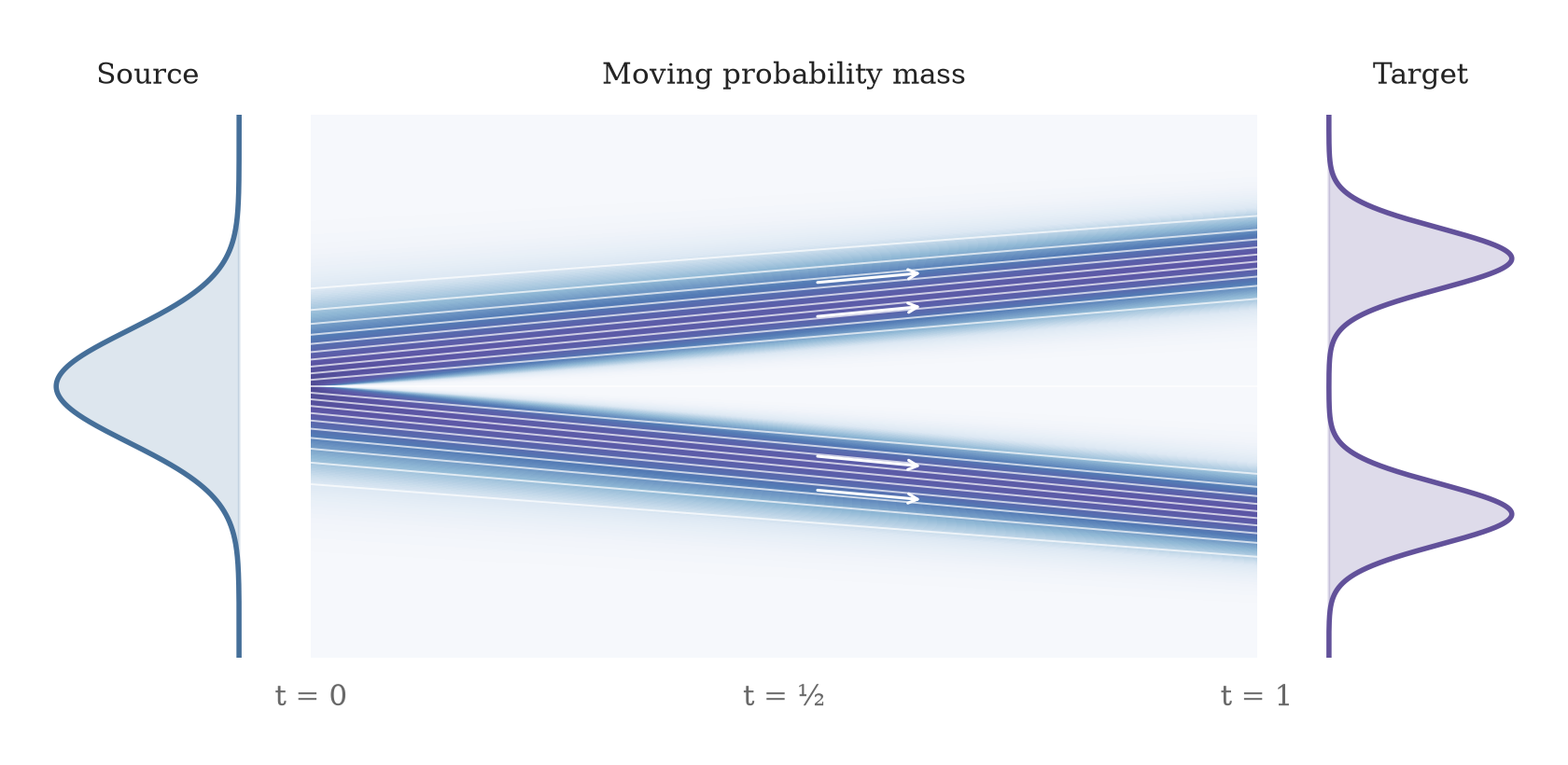
Sometimes the object to estimate is an entire distribution, carrying both variability and uncertainty. Optimization then asks how to reshape probability mass, and which geometry makes that change meaningful.
Even a simple distribution can evolve into one with several distinct modes. Following the movement of its mass makes this transformation visible: geometry shapes both the path and the algorithms that travel along it.
How should distributions be compared, and how can their geometry guide efficient algorithms? These questions connect optimal transport, statistical modeling, and optimization over measures.